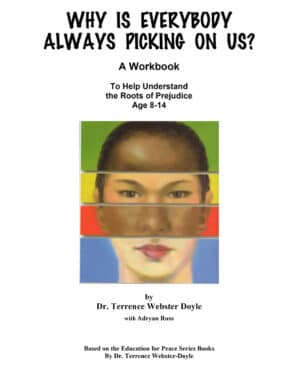
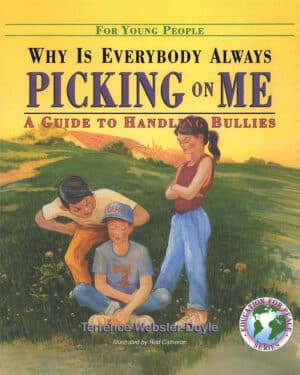
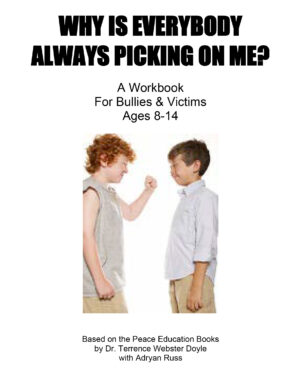
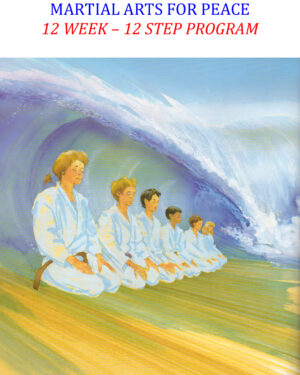
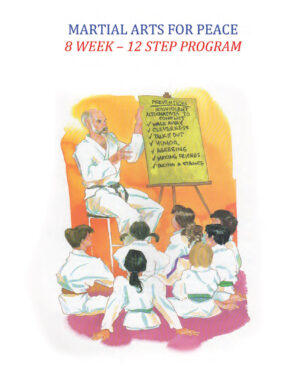
Illustration from the Internationally Acclaimed, Award Winning Book Tug of War - Peace Through Understanding Conflict
“Showing how political cartoons can condition one to think of people as subhuman and therefore as a threat needing to be exterminated”
“Helps young people deal with conflict and violence by describing practical skills for peace." - Holistic Education Review
resources: Overview
If you would like more information about requesting or donating Youth Peace Literacy resources, please contact us at the Atrium Society.
In order to be literate to bring about an understanding of the root causes of conflict – conditioned thinking – one has to have the resources that give parents, teachers and young people the ability to intellectually and realistically grasp what the roots of conflict are. Therefore these resources must be able to address this need in a holistic and integrated way. This means to be able to look at conflict, at violence, as it is without any glorification of it or by resisting it by promoting idealistic sentimentalized views of “peace”. What we generally have in regards to “peace educating books” and curricula to “teach peace” are idealistic, romanized versions of what we think peaceful behavior should be. Or on the other hand we glorify violence by promoting books, comic books, video games and movies that encourage violence as a heroic cultural ideal, one that is regarded as patriotic and noble. Rarely do we promote resources for parents, teachers and young people that look directly at violence without any judgment.
The Youth Peace Literacy internationally acclaimed, award winning books help liberate children from the conditioned, divisive thinking at the root of conflict, bullying, racism and war. Using stories, activities, games, role-playing, and colorful and thought-provoking illustrations, these books help young people aged 8 to 15 learn practical skills for solving problems without violence. These books don't talk down to children; instead, they teach children how to examine their own conditioning and be free of it. They encourage young people to think for themselves – they don’t moralize or patronize. Instead they help young people to inquire, to gain insight into the roots of conflict and by so doing being able to end it within them selves in the way they have been conditioned to think.
Selected by the International Association of Educators for World Peace for their Central American peace education project in Panama and El Salvador
Acclaimed at the Soviet Peace Fund Conference in Moscow and published in Russia by Moscow's Library of Foreign Literature and Magistr Publications
No matter how noble the Utopian intention, trying to bring about peace only creates more conflict. It sounds strange, but it's true. Think of the countries at war today and how long they've been trying to work toward peace. The very means by which we think we will attain peace is the very means that is creating disorder and conflict.
Our books are not books about "how to" get peace. The intent of our books are to help young people understand what prevents peace by understanding the root causes of conflict. This may sound like a contradiction, but the difference is essential.
Life can be incredibly violent. Young people today face a world of tremendous pressure. Our daily relationships are mainly based on competition —one person pitted against another person in an aggressive battle for survival of the individual self. We are, however, also in a period providing many opportunities for increasing our understanding and compassion. Most humans truly want cooperation rather than violence, and some doors are beginning to open.
Traditionally, the approach to peace has been through trying to live according to some philosophical, religious or political ideal. The logic has been simple and straightforward:
We are violent.
We must not be violent.
We should be peaceful.
In order to be peaceful,
we must get rid of our violence
and act nonviolently.
This type of "I should be peaceful -- I should not be violent" thinking, is one of the basic ways the mind tries to create order. In attempting to create order, however, we are thrown into deep conflict over what we should or should not do. And this is the problem.
There are many groups of people who are working toward bringing about world peace. Some of them use this should/should not kind of thinking. Some see the world as it is; others see it as they want it to be. Consider them:
The New Age Romantics. This group works to bring about world peace by "visualizing" it. They believe that in order to have a wonderful world, we have to imagine one. They visualize a world different from the one we have, and see that we do not have to accept what exists now. The "visualizing" creates the ideal, the Utopia, the "should," and hence create more conflict between what is and what ought to be.
The "We are One" Proclaimers. These people proclaim that we are already one, and that the only thing standing in the way of world peace is the inability to see the simple truth of our "real" nature. The fact, however, is that right now in the world we are not one. We are divided, fragmented human beings. All else is theoretical and therefore illusory.
The Radical Activists. These intelligent, well-meaning people advocate getting involved in politics and protesting war, hunger, pollution and all the social ills of mankind. Their actions are fragmented and limited, but they do see that we have created our social problems and that we, therefore, are the ones who can end them. But this is not getting to the root of the problem.
The Violent Revolutionaries. These people are also concerned with ending war, pollution and hunger, but they believe that the only way to a solution is through revolution. They believe this so strongly that they will sometimes die or kill others for a cause. These people are often disillusioned with life, or they are so oppressed and mistreated that they see few other alternatives for getting what they want or need.
The Intellectuals. They ponder the problems of war. They read, write books, lecture to millions of people, and receive awards and degrees for their thoughts. Their ideals are lofty; their words mystify and inspire. They present "solutions" to the problems of humanity, and express them in clever ways. They mean well, but they have not been able to stop war. They are like the "visualizers," but are more sophisticated and educated.
Alternative Communities. In pursuit of an illusive life of peace, many people have joined "alternative" communities. They have dropped out of the "norm" to create new societies. They change their names, i.e., from John Smith to Running Bear Black Water, and shed their shopping mall clothing for sandals and a sarong. This is an understandable reaction to the horrors of a violent world, but often does not go beyond personal escape.
The Experts. Many of us, caught up in our day-to-day problems, have turned over the matter of world peace to "the experts" — educators, politicians, economists, psychologists, sociologists, religious leaders, anthropologists, historians. But understanding oneself and one's conflict is not a matter of expertise or specialty.
Peace can only be approached by a question that leads to the actual fact of conflict within ourselves in the way we have been conditioned to think -- not an answer. An answer only leads to more questions and therefore more answers, more ideals to follow, ideals that have divided the human race into fragmentary ethnocentric tribal belief systems that by their very nature create conflict. Peace cannot be approached by an ideal or Utopian plan. Utopian plans, no matter how noble, create conflict because they are based on how we think life should be.
In order to bring about peace, we need to understand what is not peace; we need to look at what prevents peace. What prevents peace is conflict -- conflict in our minds, in our thinking, and in our actions -- and conflict is often exacerbated in trying to solve the problems conflict creates. We have either been shying away from our conflicts or fighting over them -- not looking at them directly, face-to-face, without judgment or condemnation.
When we deny, condemn or run away from who and what we are (violent beings), and conform to what we should or would like to be (nonviolent beings), we only create more conflict.
Our work towards peace has failed because we continue to think of how to solve the problem of peace -- how to fix it and make it work.
In order to understand why there is conflict between us, we must ask:
- Where does this division come from?
- What is the root of this violence in ourselves?
- What causes a person to call me his enemy?
- What can we do together to understand the conflict between us?
There are those who believe that this subject matter is much too complicated — that if adults cannot deal with these issues, how can we expect young people to deal with them? I believe young people have a good chance of understanding what it means to live peacefully because they haven't yet become entrenched in the complexity of violence or of trying to be peaceful. They also tend to be more open to looking at something new than we over-educated adults who have experienced many unsuccessful attempts to put an end to conflict and war.
These books are intended to awaken young people to the nature and structure of conflict, to the root causes of violence. To help them understand the concepts in these books, I would recommend that you read and discuss it with them. I ask only that they look, question, and find out for themselves if what is being said is true. You can help them most by making the discovery enjoyable. This is the most significant aspect of educating our children -- giving them the gift of understanding themselves in relationship.